

What Is V2X (Vehicle-to-everything)?
Imagine an office on a warm afternoon. Cooling is still running, but rooftop solar output is falling. Two electric cars are plugged in downstairs: one leaves at five, the other at eight. Could either help power the building and still be ready for the trip home?
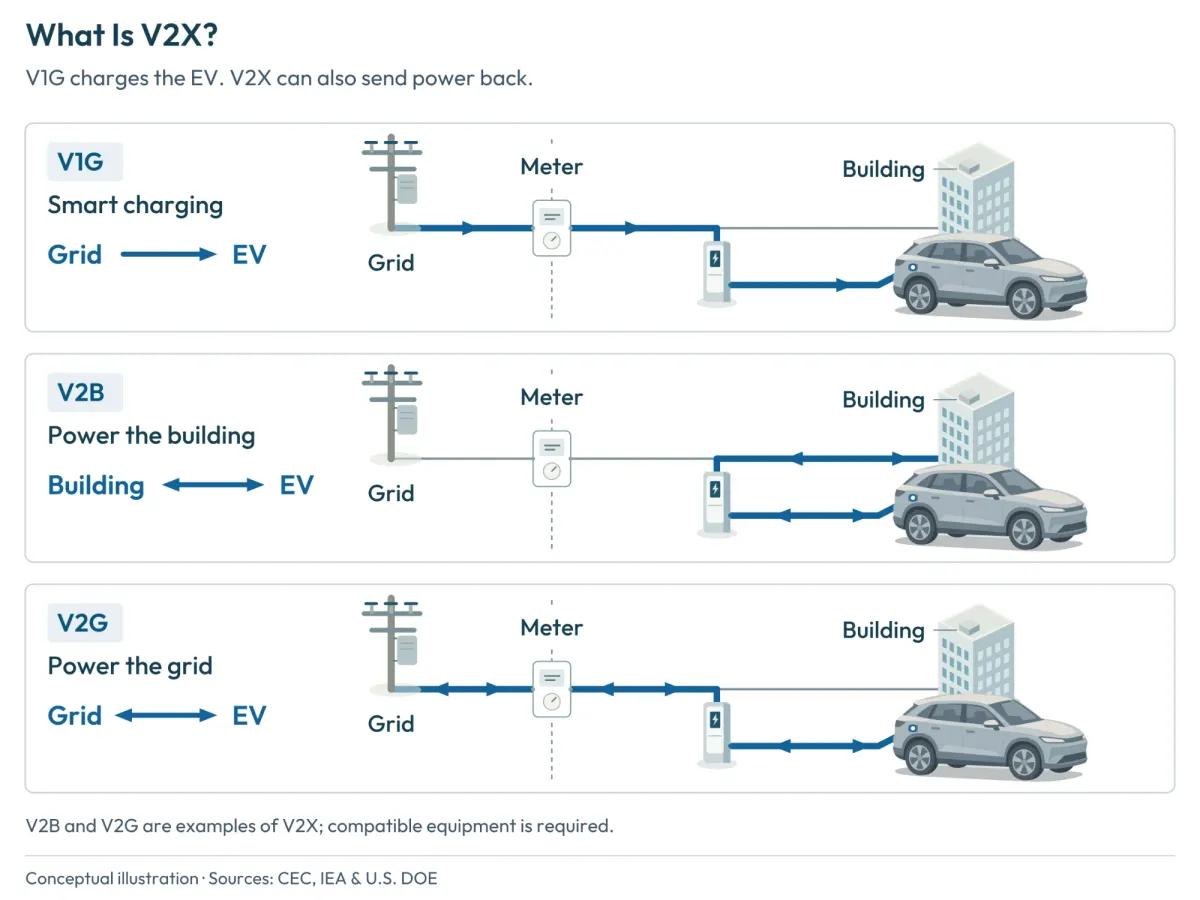
Our previous article explored how buildings can reduce, shift, generate, and store energy. EVs add mobile batteries to those choices. Managed charging, often called V1G, adjusts when or how fast a car charges—for example, to use midday solar or avoid a building’s peak demand—while still meeting the driver’s travel needs.
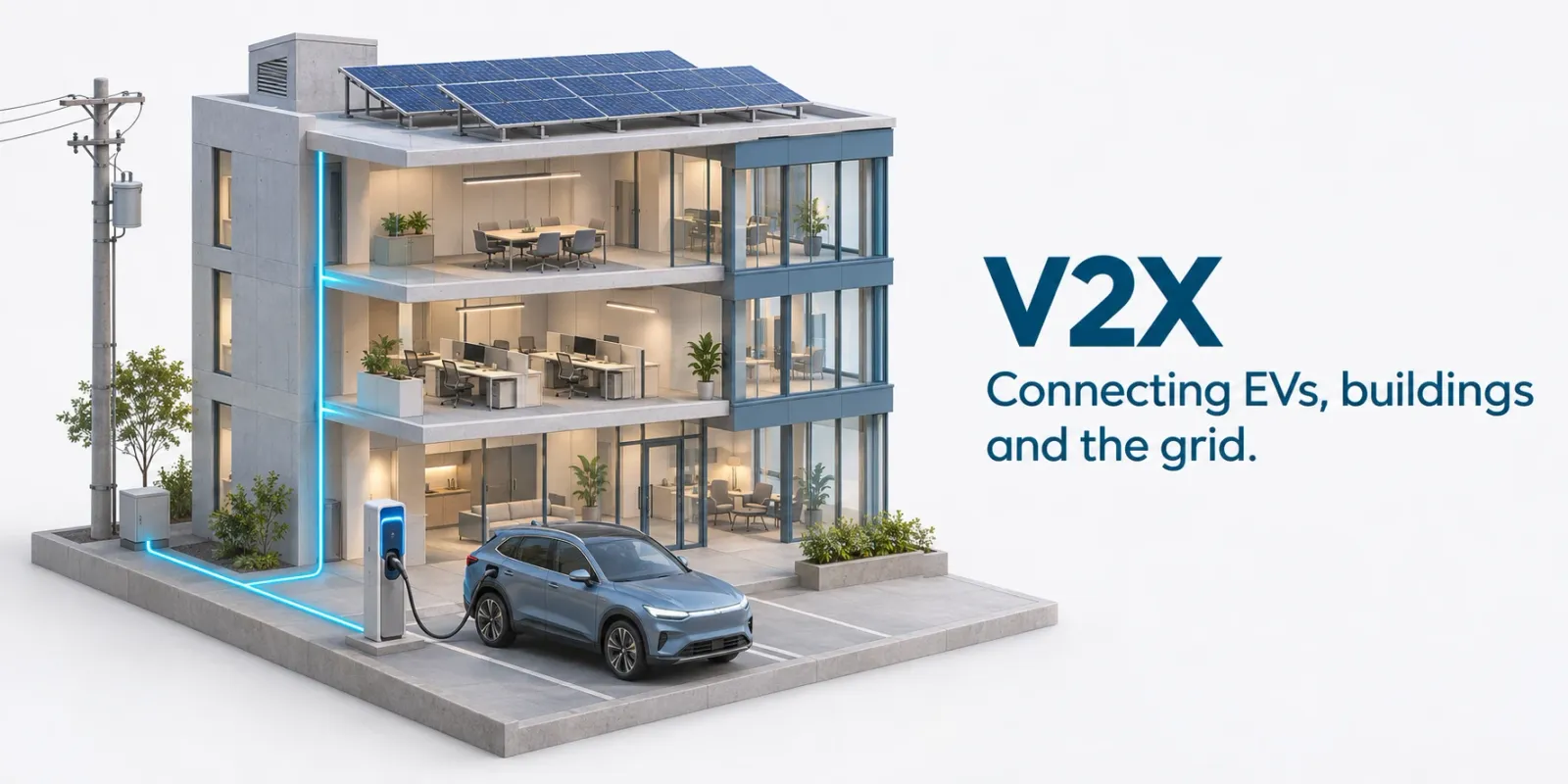
Vehicle-to-everything (V2X) goes a step further: with a compatible vehicle, charger, and connection, the battery can supply electricity to a home (V2H), a building (V2B), or the grid (V2G). Here, V2X refers to these energy applications, which give a parked car a role beyond transport [1] [2].
EV Growth Calls for Smarter Energy Coordination
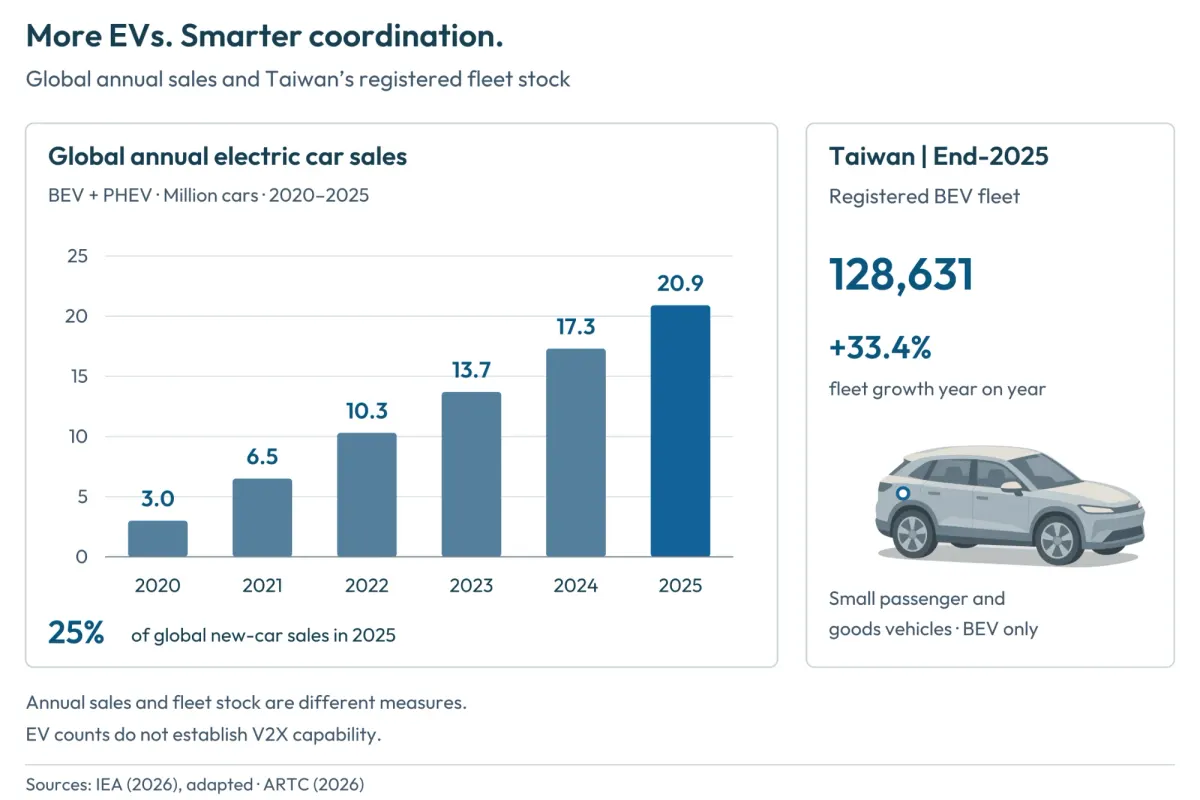
Electric cars are becoming a larger part of everyday transport. Global sales of electric cars—including battery electric vehicles (BEVs) and plug-in hybrid electric vehicles (PHEVs)—exceeded 20 million in 2025, up 20% from 2024, and accounted for 25% of new car sales [3]. In Taiwan, the registered BEV fleet reached 128,631 at the end of 2025, up 33.4% from the previous year [4].
More EVs mean more batteries connecting to buildings and local grids. Coordinating their charging with other electricity needs becomes increasingly important, bringing V2X into focus as another option for managing energy [1].
How Global Projects Use V2X to Create Value
V2X is being explored in homes, workplaces, and transport fleets. The common idea is to make parked batteries useful when people do not need them for travel. Different settings create different opportunities to save money, support the grid, or develop new services.
Japan: Parked EVs Can Reduce Buildings’ Peak-Time Grid Demand
In Japan, Nissan began a V2B test at its Advanced Technology Center in Atsugi in July 2013, connecting up to six LEAFs to supply buildings. The test reported an approximately 2.5% reduction in electricity drawn from the grid during peak hours [5]. For building operators, this shows how parked cars can become part of an energy strategy, supplying electricity during busy periods and reducing reliance on the grid.
Britain: Charging Credits Reward Drivers for Providing Flexibility
Britain’s Octopus Power Pack schedules charging and export for participating households, then credits eligible EV charging costs. The supplier estimates annual savings of £161 compared with Intelligent Octopus Go, its smart-charging tariff [6]. For drivers, the offer turns time spent plugged in into a household benefit: they allow the service to coordinate their car’s battery in exchange for charging credits.
United States: School-Bus Batteries Can Support the Grid
In Oakland, California, PG&E announced 74 electric school buses with bidirectional chargers in 2024; Zūm’s 2025 update reports grid export while buses are idle [7] [8]. For the fleet operator, the same battery supports two jobs: transporting students and providing electricity when the buses are parked.
Australia: Fleet V2G Needs Tariffs and Revenue Sharing That Work
Australia’s REVS2 project is exploring how fleet V2G could become a viable service. Running from 2026 to 2029, it plans to deploy up to 130 bidirectional chargers to support up to 130 battery-electric vehicles at Australian Capital Territory Government and Australian National University sites. The project will test how electricity pricing, charging management and revenue sharing can reduce the overall cost of owning and operating a fleet [9]. The goal is to help fleet operators earn value from parked vehicles while keeping them ready for daily transport needs.
When Does V2X Add Value?
Return to the office in our opening example. The building’s electricity demand peaks in the early evening. A car leaving at 5 p.m. will miss that window; one staying until 8 p.m. may be available to help. But can it supply the building and still have enough charge for the journey home?
Managed charging adjusts when and how fast the car charges. V2B adds the option of supplying electricity to the building. Whether that extra flexibility is useful depends partly on when the car is plugged in and when the building needs power [1].
Follow the car that stays until 8 p.m. Turn on Compare with V2B to see how the building’s grid power draw changes. In both schedules, the car arrives at 9 a.m. with its 60 kWh battery at 20% charge and must leave at 8 p.m. with 80%. Building demand and rooftop solar output are the same, and both strategies can charge the car at up to 7.2 kW.
A lower peak is one part of the picture. The comparison also needs to account for recharging, energy lost during charging and discharging, equipment costs, and battery wear. Lower peak demand, lower electricity use, lower costs, and lower emissions are different outcomes; they do not necessarily improve together.
This illustrative scenario helps explain why timing matters. Real projects also need to consider how these decisions interact with the local grid.
E3 Research Connects Building Decisions with Local Grid Conditions
Yeoh et al. [10] modeled combinations of solar generation, V2B, and stationary storage at selected NTU facilities, comparing grid energy use, peak demand, costs, and emissions. These scenarios help examine how resources work together and how the preferred configuration depends on operating priorities.
Tu et al. [11] extended coordination to building cost and feeder power losses, using a 140-EV fleet on the IEEE 33-bus test network. Their rolling-horizon framework updates schedules under uncertain vehicle movements, building demand, and solar forecasts, examining trade-offs between site economics and network performance.
For building and fleet operators, these studies suggest a practical starting point: compare departure times, solar output, and tariffs to see when V2X adds value beyond managed charging. Those comparisons can also guide a pilot by showing which data to collect and which operating conditions to test.
E3 Center welcomes building and fleet operators, charging-system developers, and energy partners to explore that question through scenario modeling and coordinated energy-system analysis. Contact E3 Center to discuss potential industry–academic collaboration.
References
[1] International Energy Agency. (2026, May 20). Vehicle-to-grid technology. https://www.iea.org/reports/vehicle-to-grid-technology
[2] U.S. Department of Energy. (n.d.). Bidirectional charging and electric vehicles for mobile storage. https://www.energy.gov/cmei/femp/bidirectional-charging-and-electric-vehicles-mobile-storage
[3] International Energy Agency. (2026). Global EV outlook 2026. https://www.iea.org/reports/global-ev-outlook-2026
[4] 邱冠慈. (2026, February 5). 2025年國內電動車市場概況與發展趨勢 [Taiwan’s electric vehicle market in 2025 and development trends]. 財團法人車輛研究測試中心 [Automotive Research & Testing Center]. https://www.artc.org.tw/tw/knowledge/articles/13846
[5] Nissan Motor Corporation. (n.d.). Expansion of vehicle usage. https://www.nissan-global.com/EN/SUSTAINABILITY/ENVIRONMENT/GREENPROGRAM/CLIMATE/EFFECTIVE-USE/
[6] Octopus Energy. (2026). Octopus Power Pack: The UK’s first vehicle-to-grid tariff. Retrieved November 5, 2026, from https://octopus.energy/power-pack/
[7] Doherty, P. (2024, August 27). PG&E helps Zum deploy nation’s first 100% electric school bus fleet in Oakland for new school year. Pacific Gas and Electric Company. https://www.pge.com/en/newsroom/currents/future-of-energy/articles-4040-pge-helps-zum-deploy-nations-100-electric-school-bus-fleet-oakland-new-school-year.html
[8] Zūm. (2025, August 19). Back to school 2025: Oakland, CA. https://www.ridezum.com/blog/back-to-school-2025-oakland-ca
[9] Australian Renewable Energy Agency. (2026, October 21). REVS2: Commercialising fleet V2G. https://arena.gov.au/projects/revs2-commercialising-fleet-v2g/
[10] Yeoh, J. H., Lo, K.-Y., & Hsieh, I.-Y. L. (2025). Optimizing urban energy flows: Integrative vehicle-to-building strategies and renewable energy management. Energy Conversion and Management: X, 26, Article 100974. https://doi.org/10.1016/j.ecmx.2025.100974
[11] Tu, Y.-Y., Yeoh, J. H., Shei, C.-H., & Hsieh, I.-Y. L. (2026). Vehicle-to-building energy management for coordinated building and feeder operation under forecast uncertainty: A system-of-systems framework. IEEE Systems Journal, 1–11. https://doi.org/10.1109/JSYST.2026.3727774